> ## Documentation Index
> Fetch the complete documentation index at: https://felimet-hub.jmcores.com/llms.txt
> Use this file to discover all available pages before exploring further.

# Water pollution analysis with GLCM and schlieren imaging

> Automation 2025 paper integrating Z-type schlieren, near-infrared spectroscopy, and GLCM texture features to build a turbidity model for water pollution.

export const CiteSwitch = ({bibtex = "", lang = "zh"}) => {
  const t = lang === "en" ? {
    hint: "Switch citation format",
    copy: "Copy",
    copied: "Copied"
  } : {
    hint: "切換引用格式",
    copy: "複製",
    copied: "已複製"
  };
  const [fmt, setFmt] = useState("bibtex");
  const [copied, setCopied] = useState(false);
  const raw = (bibtex || "").trim();
  const field = name => {
    const m = raw.match(new RegExp(name + "\\s*=\\s*[{\"]([^{}\"]*)[}\"]", "i"));
    return m ? m[1].replace(/\s+/g, " ").trim() : "";
  };
  const typeM = raw.match(/@(\w+)/);
  const isConf = typeM ? (/inproceedings|conference/i).test(typeM[1]) : false;
  const title = field("title");
  const journal = field("journal");
  const booktitle = field("booktitle");
  const year = field("year");
  const volume = field("volume");
  const number = field("number");
  const doi = field("doi").replace(/^\s*(https?:\/\/)?(dx\.)?doi\.org\//i, "").replace(/^doi:\s*/i, "").trim();
  const address = field("address");
  const pages = field("pages").replace(/(\d)\s*-+\s*(\d)/g, "$1–$2");
  const splitName = name => {
    const n = name.trim();
    if (n.includes(",")) {
      const p = n.split(",");
      return {
        last: p[0].trim(),
        first: p.slice(1).join(",").trim()
      };
    }
    const p = n.split(/\s+/);
    const last = p.pop();
    return {
      first: p.join(" "),
      last
    };
  };
  const initialsOf = first => {
    const parts = first.split(/[\s-]+/).filter(Boolean);
    const ini = parts.map(p => p[0].toUpperCase() + ".");
    return first.includes("-") ? ini.join("-") : ini.join(" ");
  };
  const names = field("author") ? field("author").split(/\s+and\s+/).map(splitName) : [];
  const joinList = (arr, amp) => {
    if (arr.length <= 1) return arr[0] || "";
    if (arr.length === 2) return arr.join(amp ? ", & " : " and ");
    const sep = amp ? ", & " : ", and ";
    return arr.slice(0, -1).join(", ") + sep.replace(/^, /, ", ") + arr[arr.length - 1];
  };
  const ieeeAuthors = joinList(names.map(n => (initialsOf(n.first) + " " + n.last).trim()), false);
  const apaAuthors = joinList(names.map(n => (n.last + ", " + initialsOf(n.first)).trim()), true);
  const ieeeRest = isConf ? [booktitle && "in " + booktitle, address, year, pages && "pp. " + pages].filter(Boolean).join(", ") : [journal, volume && "vol. " + volume, number && "no. " + number, pages && "pp. " + pages, year, doi && "doi: " + doi].filter(Boolean).join(", ");
  const ieee = `${ieeeAuthors}, "${title}," ${ieeeRest}.`.replace(/\s+/g, " ");
  const apaVol = volume ? volume + (number ? "(" + number + ")" : "") : "";
  const apa = isConf ? `${apaAuthors} (${year}). ${title}. ${booktitle ? "In " + booktitle + (address ? ", " + address : "") : address}.`.replace(/\s+/g, " ") : `${apaAuthors} (${year}). ${title}. ${[journal, apaVol, pages].filter(Boolean).join(", ")}.${doi ? " https://doi.org/" + doi : ""}`.replace(/\s+/g, " ");
  const TABS = [{
    key: "bibtex",
    label: "BibTeX"
  }, {
    key: "ieee",
    label: "IEEE"
  }, {
    key: "apa",
    label: "APA"
  }];
  const current = fmt === "bibtex" ? raw : fmt === "ieee" ? ieee : apa;
  const doCopy = () => {
    try {
      navigator.clipboard.writeText(current);
      setCopied(true);
      setTimeout(() => setCopied(false), 1500);
    } catch (e) {
      setCopied(false);
    }
  };
  const css = `
  .cs-root{--cs-bg:#FAF8F3;--cs-surface:rgba(0,0,0,0.025);--cs-border:rgba(0,0,0,0.09);--cs-text:#2b2722;--cs-dim:#6f6a62;--cs-faint:#8a8378;--cs-accent:#bf7551;--cs-code:rgba(0,0,0,0.04);border:1px solid var(--cs-border);border-radius:14px;background:var(--cs-bg);color:var(--cs-text);overflow:hidden;}
  .dark .cs-root{--cs-bg:#1b1a18;--cs-surface:rgba(255,255,255,0.03);--cs-border:rgba(255,255,255,0.08);--cs-text:#e7e3da;--cs-dim:#a8a299;--cs-faint:#8a8378;--cs-accent:#cf8a68;--cs-code:rgba(255,255,255,0.05);}
  .cs-head{display:flex;align-items:center;gap:8px;padding:10px 12px;border-bottom:1px solid var(--cs-border);flex-wrap:wrap;}
  .cs-head-ic{color:var(--cs-accent);flex-shrink:0;}
  .cs-hint{font-size:12px;color:var(--cs-faint);margin-right:auto;}
  .cs-tab{border:1px solid var(--cs-border);background:transparent;border-radius:8px;padding:5px 12px;cursor:pointer;color:var(--cs-dim);font:inherit;font-size:12.5px;font-weight:600;transition:all .15s;}
  .cs-tab:hover{background:var(--cs-surface);}
  .cs-tab-on{border-color:rgba(191,117,81,.5);background:rgba(191,117,81,.1);color:var(--cs-accent);}
  .cs-body{position:relative;padding:14px 15px;}
  .cs-pre{margin:0;font-family:ui-monospace,SFMono-Regular,Menlo,Consolas,monospace;font-size:12.5px;line-height:1.6;white-space:pre-wrap;word-break:break-word;color:var(--cs-text);}
  .cs-cite{font-size:13.5px;line-height:1.7;color:var(--cs-text);word-break:break-word;}
  .cs-copy{position:absolute;top:11px;right:12px;display:flex;align-items:center;gap:5px;border:1px solid var(--cs-border);background:var(--cs-bg);border-radius:8px;padding:5px 10px;cursor:pointer;color:var(--cs-dim);font:inherit;font-size:11.5px;font-weight:600;transition:all .15s;}
  .cs-copy:hover{border-color:rgba(191,117,81,.5);color:var(--cs-accent);}
  .cs-copy-ok{color:#5f8a52;border-color:rgba(95,138,82,.4);}
  .dark .cs-copy-ok{color:#86b274;}
  .cs-copy svg{flex-shrink:0;}
  `;
  return <div className="cs-root">
      <style>{css}</style>
      <div className="cs-head">
        <svg className="cs-head-ic" xmlns="http://www.w3.org/2000/svg" width="15" height="15" viewBox="0 0 24 24" fill="none" stroke="currentColor" strokeWidth="2" strokeLinecap="round" strokeLinejoin="round"><path d="M10 8h8" /><path d="M6 8h.01" /><path d="M6 12h.01" /><path d="M6 16h.01" /><path d="M10 12h8" /><path d="M10 16h4" /><rect width="20" height="18" x="2" y="3" rx="2" /></svg>
        <span className="cs-hint">{t.hint}</span>
        {TABS.map(tab => <button key={tab.key} type="button" className={"cs-tab" + (fmt === tab.key ? " cs-tab-on" : "")} onClick={() => setFmt(tab.key)}>{tab.label}</button>)}
      </div>
      <div className="cs-body">
        <button type="button" className={"cs-copy" + (copied ? " cs-copy-ok" : "")} onClick={doCopy}>
          {copied ? <svg xmlns="http://www.w3.org/2000/svg" width="13" height="13" viewBox="0 0 24 24" fill="none" stroke="currentColor" strokeWidth="2.5" strokeLinecap="round" strokeLinejoin="round"><path d="M20 6 9 17l-5-5" /></svg> : <svg xmlns="http://www.w3.org/2000/svg" width="13" height="13" viewBox="0 0 24 24" fill="none" stroke="currentColor" strokeWidth="2" strokeLinecap="round" strokeLinejoin="round"><rect width="14" height="14" x="8" y="8" rx="2" /><path d="M4 16c-1.1 0-2-.9-2-2V4c0-1.1.9-2 2-2h10c1.1 0 2 .9 2 2" /></svg>}
          {copied ? t.copied : t.copy}
        </button>
        {fmt === "bibtex" ? <pre className="cs-pre">{raw}</pre> : <div className="cs-cite">{current}</div>}
      </div>
    </div>;
};

export const PubMeta = ({type = "journal", venue, date, confType, doi, url}) => {
  const doiUrl = doi ? doi.startsWith("http") ? doi : `https://doi.org/${doi}` : null;
  const pillBase = {
    display: "inline-block",
    padding: "0.15rem 0.6rem",
    borderRadius: "9999px",
    fontSize: "0.78rem",
    fontWeight: 600,
    lineHeight: 1.6,
    border: "1px solid"
  };
  const tone = {
    type: {
      color: "#8a9a7b",
      borderColor: "rgba(138,154,123,0.4)",
      background: "rgba(138,154,123,0.1)"
    },
    venue: {
      color: "#c9a35b",
      borderColor: "rgba(201,163,91,0.4)",
      background: "rgba(201,163,91,0.1)"
    },
    date: {
      color: "#5b6c8f",
      borderColor: "rgba(91,108,143,0.4)",
      background: "rgba(91,108,143,0.1)"
    },
    link: {
      color: "#bf7551",
      borderColor: "rgba(191,117,81,0.4)",
      background: "rgba(191,117,81,0.1)"
    }
  };
  const typeLabel = type === "conference" ? "Conference" : "Journal";
  return <div style={{
    display: "flex",
    flexWrap: "wrap",
    gap: "0.5rem",
    alignItems: "center",
    marginBottom: "1.5rem"
  }}>
      <span style={{
    ...pillBase,
    ...tone.type
  }}>{typeLabel}</span>
      {venue && <span style={{
    ...pillBase,
    ...tone.venue
  }}>{venue}</span>}
      {date && <span style={{
    ...pillBase,
    ...tone.date
  }}>{date}</span>}
      {confType && <span style={{
    ...pillBase,
    ...tone.type
  }}>{confType}</span>}
      {doiUrl && <a href={doiUrl} target="_blank" rel="noopener noreferrer" style={{
    ...pillBase,
    ...tone.link,
    textDecoration: "none"
  }}>
          DOI ↗
        </a>}
      {url && <a href={url} target="_blank" rel="noopener noreferrer" style={{
    ...pillBase,
    ...tone.link,
    textDecoration: "none"
  }}>
          Link ↗
        </a>}
    </div>;
};

<PubMeta type="conference" venue="The 22th International Conference on Automation Technology (Automation 2025)" date="2025-11-28" confType="Oral" url="https://automation2025.nsysu.edu.tw" />

# Quantitative Water Pollution Analysis System Integrating GLCM Image Features with Schlieren Imaging Technology

Jia-Ming Zhou, Wen-Lin Chu, and Bo-Lin Jian

## Abstract

This work presents an integrated water pollution analysis system that combines a Z-type schlieren
optical setup with near-infrared spectroscopy to monitor microparticles generated during the thermal
degradation of plastic materials in water. The proposed framework exploits the high sensitivity of
schlieren imaging to visualize subtle density variations and employs near-infrared spectral measurements
to assist particle size and concentration assessment. A feature extraction pipeline
based on Gray Level Co-occurrence Matrix (GLCM) is developed, where contrast, correlation, energy,
and homogeneity calculated over multiple distances and directions serve as inputs to a turbidity
prediction model. Experiments on PP plastics thermally degraded between 60–100°C for 60 minutes,
with synchronized measurements from a standard turbidimeter, establish a correspondence database
between image-derived features and turbidity values. Preliminary results indicate that microparticle
structures formed under different degradation conditions exhibit clearly distinguishable texture
signatures, demonstrating the feasibility of the proposed approach as a quantitative, high-precision
tool for microplastic-related water pollution monitoring and future turbidity prediction model development. The study incorporates flow velocity sensors for cross-validation to ensure analytical reliability. This innovative methodology not only reveals the blocking effects of masks on airflow propagation pathways and velocities but also provides objective scientific data to support public health epidemic prevention strategies, demonstrating significant practical application value.

## Keywords

* Color Schlieren Techniques
* Microplastic pollution
* Gray Level Co-occurrence Matrix (GLCM)
* Turbidity prediction
* Plastic thermal degradation

## Sample Results

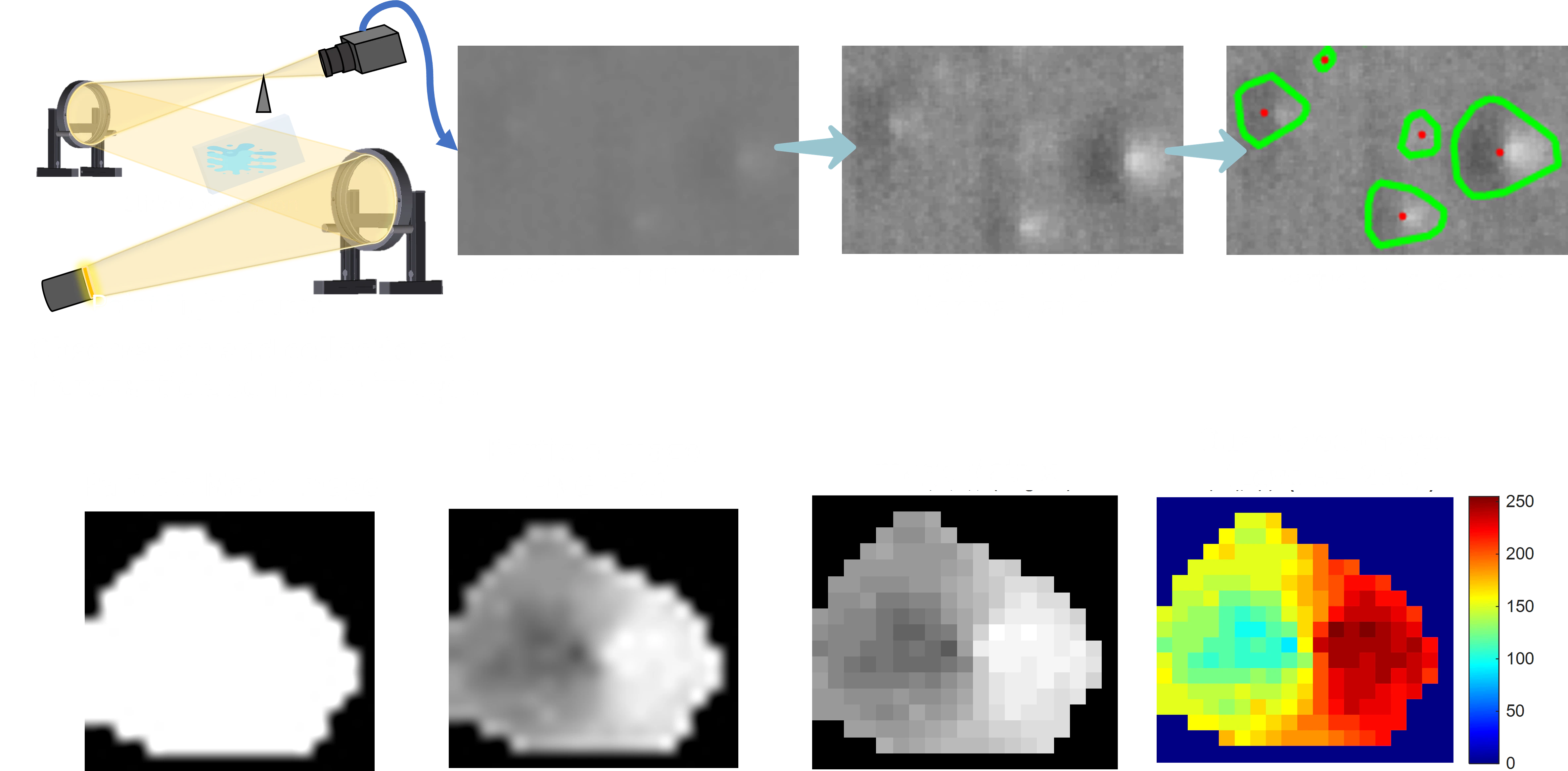
<p>The upper-left panel shows the dual-light-source schlieren optical setup, which captures refractive-index gradient variations caused by microparticles in water through a precision lens assembly and CMOS camera. This design achieves extremely high sensitivity to micrometer-scale plastic thermal degradation products.</p>
<p>The image processing pipeline begins with the original low-contrast schlieren image (upper-center gray block), proceeds through contrast enhancement and noise suppression to produce an enhanced image (second from right), and renders microparticle density disturbances as bright localized features. The rightmost image shows automated object detection results, where green contours delineate microparticle boundaries and red dots mark centroid positions, enabling real-time counting and size statistics. The four lower images illustrate the multi-stage transformation for GLCM texture feature extraction. The left binarization mask separates foreground from background; the grayscale intensity field retains the original light-intensity information for subsequent statistical computation; the third image quantifies texture statistics in a specific direction (e.g., contrast or energy spatial distribution); and the rightmost heatmap integrates GLCM features across multiple directions (0°, 45°, 90°, 135°) and distance parameters, with a 0–250 color scale encoding numerical values: red high-value regions correspond to areas of high microparticle density or peak texture complexity.</p>
<p>The experimental design uses PP plastics thermally degraded at 60–100°C for 60 minutes, with simultaneous recording of standard turbidimeter readings and schlieren image data. Microparticle structures produced under different degradation conditions exhibit distinguishable textures in the four-dimensional GLCM feature space (contrast, correlation, energy, homogeneity), providing preliminary validation of the feasibility of predicting turbidity values from optical features and offering a high-precision prototype tool for non-contact microplastic pollution quantitative monitoring.</p>

<img src="https://mintcdn.com/felimet/o4nUK2uwNPSF27VA/images/auto2025_demo.png?fit=max&auto=format&n=o4nUK2uwNPSF27VA&q=85&s=9d67d4af68108b65fc523c34274342d2" alt="Demo" width="4738" height="2329" data-path="images/auto2025_demo.png" />

## BibTeX Citation

<CiteSwitch
  lang="en"
  bibtex={`@inproceedings{zhou2025automation,
author    = {Jia-Ming Zhou and Wen-Lin Chu and Bo-Lin Jian},
title     = {Quantitative Water Pollution Analysis System Integrating GLCM Image Features with Schlieren Imaging Technology},
booktitle = {The 22nd International Conference on Automation Technology (Automation 2025)},
year      = {2025},
month     = {November},
address   = {Kaohsiung, Taiwan}
}`}
/>