Epidemic Prevention Applications of Color Schlieren Thermal Dynamics Imaging
Jia-Ming Zhou, and Bo-Lin JianAbstract
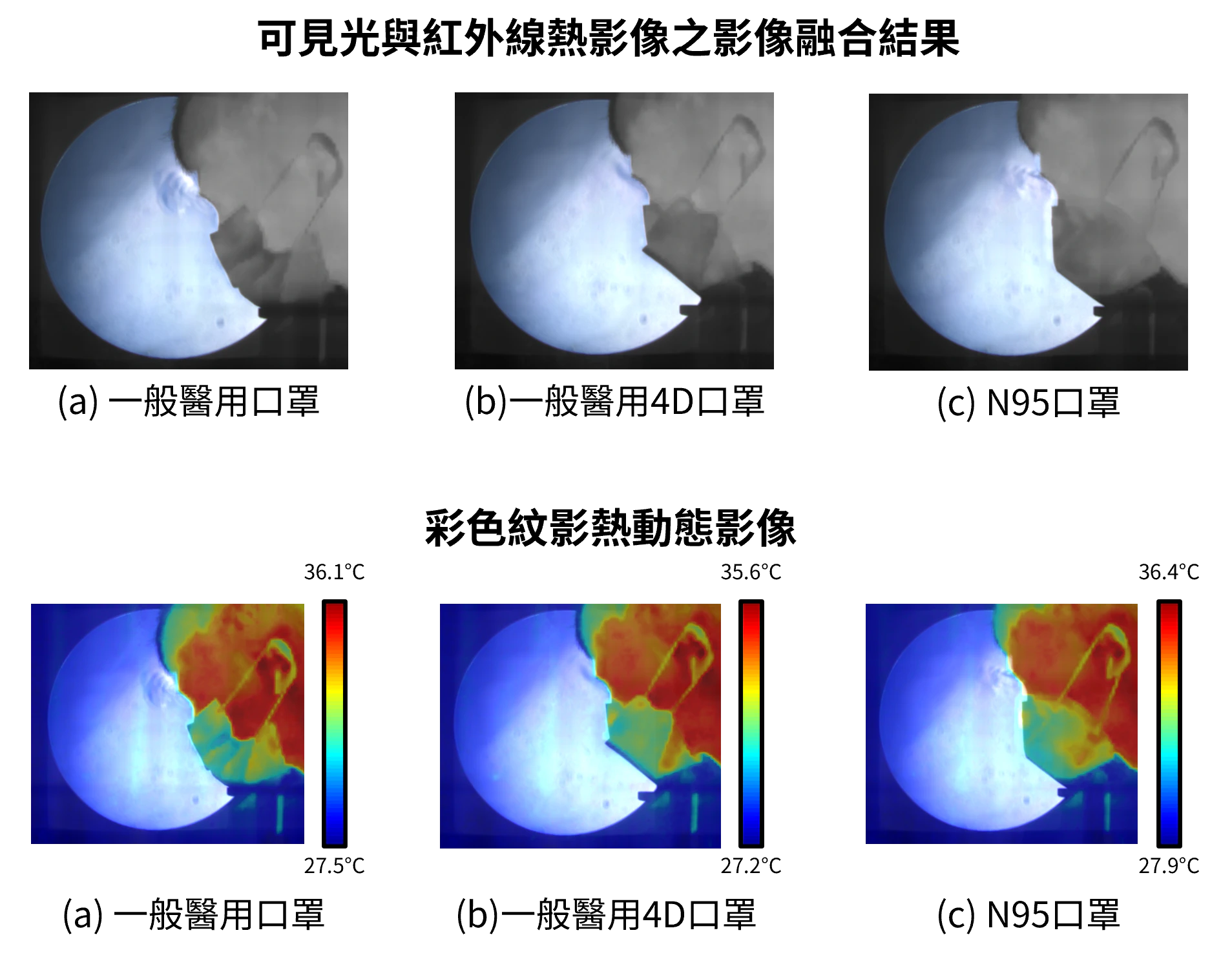
This study establishes a dual-modal visualization system integrating schlieren optics and infrared thermal imaging for quantitative analysis of respiratory airflow dynamics during mask wearing. The research employs Robust Principal Component Analysis (RPCA) to decompose dynamic imagery into low-rank matrices (background structure) and sparse matrices (dynamic targets), and utilizes Particle Image Velocimetry (PIV) to accurately measure airflow velocity field distributions. The experimental investigation compares three mask types: standard surgical masks, 4D surgical masks, and N95 respirators. Results demonstrate that exhalation velocities from standard surgical masks reach up to 0.6 m/s, whereas N95 respirators exhibit velocities below 0.35 m/s. Through dual-modal image fusion techniques, the system successfully integrates the airflow texture from schlieren images with temperature distribution information from thermal images, generating color schlieren thermodynamic imagery. The study incorporates flow velocity sensors for cross-validation to ensure analytical reliability. This innovative methodology not only reveals the blocking effects of masks on airflow propagation pathways and velocities but also provides objective scientific data to support public health epidemic prevention strategies, demonstrating significant practical application value.Keywords
- Color Schlieren Techniques
- Robust Principal Component Analysis (RPCA)
- Particle Image Velocimetry (PIV)
- Infrared Thermal Imaging
- Impact of Masks on Respiratory Airflow
Sample Results