Actual Body Weight Estimation Method for Dairy Cattle Based on Rump Depth Images
Jia-Ming Zhou, Chu-Wen Peng, Wen-Lin Chu, Hsin-Yi Chiang, and Hsiao-Ping TsaiAbstract
With the rapid development of modern agricultural technology, precision livestock farming has gradually become an important trend for improving management efficiency, reducing costs, and promoting animal health. Traditional body weight estimation relies primarily on floor scales, a method that is highly time-consuming and requires substantial labor to guide cattle to the weighing area. To address these challenges faced by traditional farms, this study acquires cattle rump image data in a non-contact manner, accurately extracts rump features from depth images through image processing techniques, and collects actual body weights measured on the farm as ground-truth data. A new body weight estimation method is developed that uses standard-object quantification experiments to establish the relationships among distance, pixels, and actual area, thereby constructing an exponential regression model to define rump area. The extracted features are then used for machine learning and regression analysis to build an actual body weight estimation model for dairy cattle. This approach performs well for body weight estimation in adult dairy cows: the non-contact advantage enables rapid weight prediction and real-time monitoring of body weight changes, helping farms promptly adjust feeding strategies. Future research will focus on optimizing the technology (e.g., machine learning models) to improve the accuracy and speed of weight prediction, and on addressing generalizability across different environments and implementing automation technology to further advance the intelligent development of precision livestock farming.Keywords
- Dairy cattle body weight prediction
- Image processing
- Machine vision
- Exponential regression model
- Precision livestock farming
Sample Results
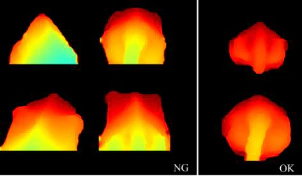
Depth images are processed through morphological operations, and a classifier is then used to categorize images as containing a complete rump or not. The left image (labeled NG) indicates no complete rump is visible; the right image (labeled OK) indicates a complete rump is present. The valid complete rump images are then used in standard-object quantification experiments to establish the relationships among distance, pixels, and actual area, and an exponential regression model is constructed to estimate cattle body weight.