A Study on Establishing a Dynamic Color Schlieren System to Observe Airflow and Predict Temperature Changes
Bo-Lin Jian and Jia-Ming ZhouAbstract
Color schlieren technique visualizes invisible fluid waves (e.g., airflows, sound waves) by utilizing color filters for airflow temperature evaluation through dynamic color distribution, offering detailed analysis advantages over infrared thermal imaging. This study adopts low-cost, transparent projector films as color filters, enhancing intuitive perception but introducing haze due to laser printing scratches, which reduces image saturation. Image dehazing techniques are applied to address this, improving image quality. Additionally, a Feedforward neural network (FNN) is used to establish a temperature prediction model based on the dynamic color distribution of Schlieren images, with the Pearson correlation coefficient and Mean Square Error (MSE) evaluating the model’s accuracy. Results show a high Pearson correlation (0.99848) and low MSE (0.6663), indicating the model’s excellent predictive capability. This approach proves feasible for non-invasive, high-temperature fluid analysis, presenting a significant advancement in fluid dynamics research.Keywords
- Airflow visualization
- Color filter
- Schlieren color temperature image
- Schlieren predicted temperature
- Temperature prediction model
Sample Results
- System Overview
- Visualization
- Comparison
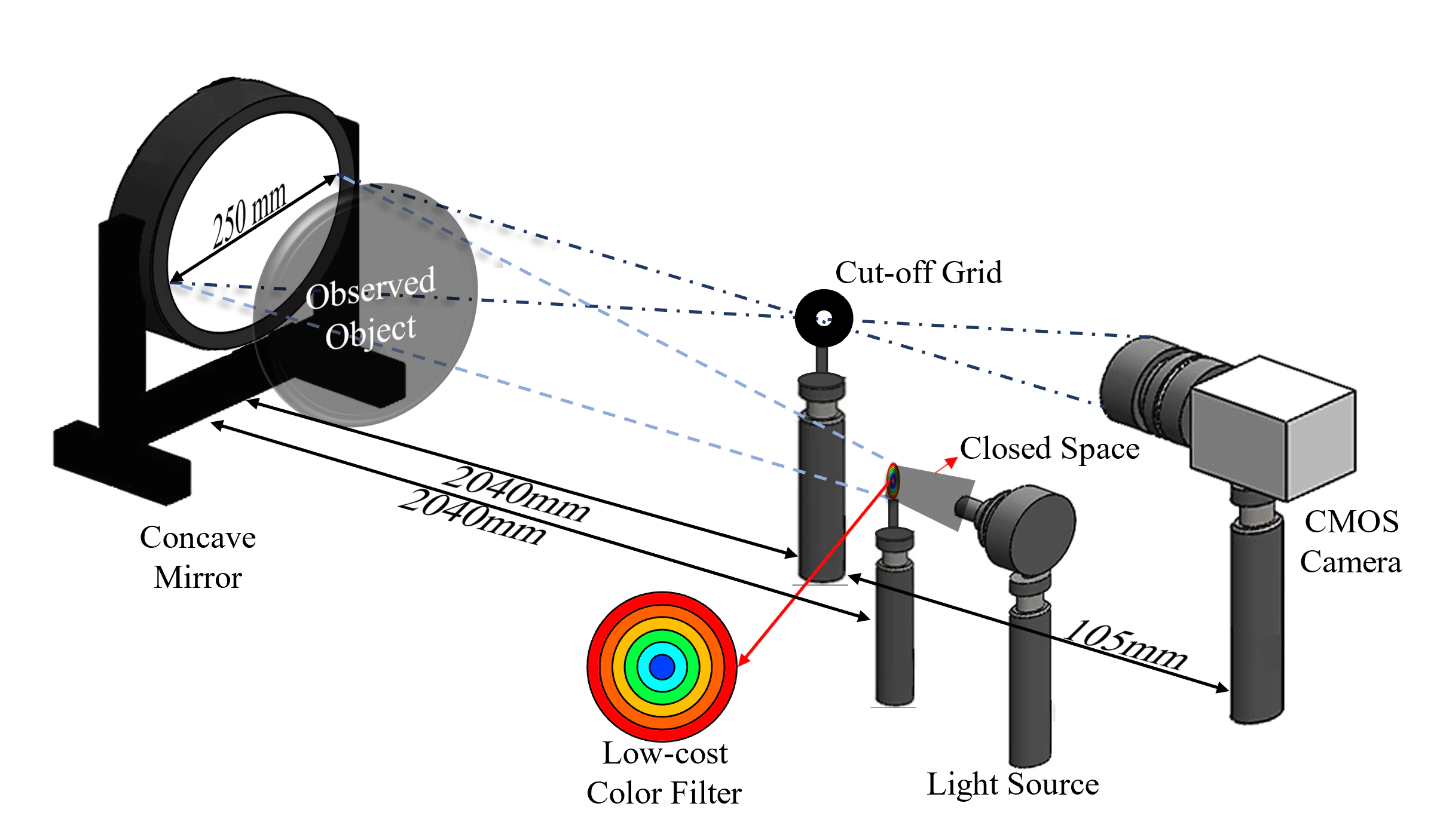
This study uses an astronomical concave mirror with a radius of curvature of 4080 mm, a diameter of 250 mm, and a focal length of 2040 mm, together with an LED light source combined with a 9 W specific-current dimmer and a CMOS camera with a resolution of 2448×2048, as the primary instruments for capturing Schlieren images. The single off-axis concave mirror Schlieren optical path system is shown in the figure below.